
Pax Silica, the Philippines and US war preparations against China
Written by: (Contributed) on 14 September 2026
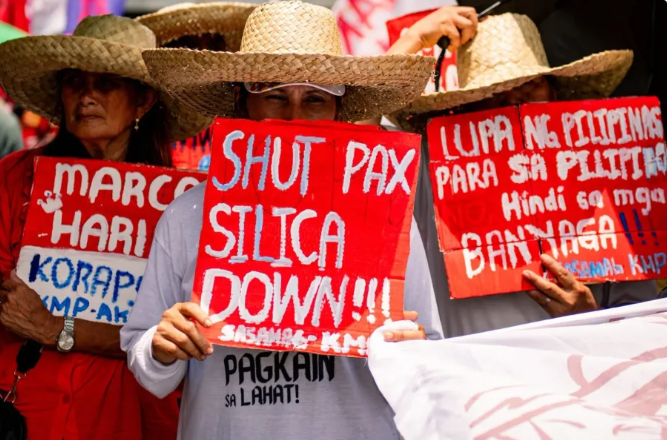
(Source: National Democratic Front of the Philippines » NDFP )
The decision by the Trump administration to re-open military facilities from the previous Cold War in the Philippines forms part of a rising tide of US-led militarism sweeping the Indo-Pacific region. Serious questions arise about Australian involvement. The proposed military facilities have been given as little publicity as possible, revealing sensitive telecommunications and intelligence provision; information forthcoming from the Philippines, however, has revealed widespread opposition to the proposals.
During December, 2025, the Trump administration finalised an agreement with the Philippines to establish a huge AI facility on 4,000 acres of land with a 99 year lease. (1)
Based in Tarlac Province, the proposed Pax Silica facility has made use of the former US Clark Air Force Base, officially closed in 1991, with the ending of the previous Cold War. (2) It was noted, furthermore, that the decision was taken in light of 'Clark's historical role as a logistics and defence hub'. (3)
The sensitive nature of the US role in both the past and present Cold War has included the base facilities being used for flights to both Guam and Diego Garcia, two US intelligence hubs swinging on an arc from the centrally-placed Pine Gap facilities in Australia. (4) Both hubs have been subject to extensive upgrading of facilities over many decades.
The interplay between data centres, AI and their military and security applications, is merely the latest addition to the US-led militarism of our age. (5) The struggle, by the US, to establish a monopoly of highly advanced technologies, forms part of what is generally referred to in military circles as the study of asymmetrical warfare techniques, and unconventional warfare. The establishment of data centres, AI and military usage has become a sophisticated form of global intelligence-gathering and signals-intelligence.
The Philippines has long been a major preoccupation with the Pentagon due to its centrality within the wider Indo-Pacific region: its history has followed endless US connivance to install presidential puppets to control the sprawling landmass; repression has always been commonplace. Governments come and go in Metro Manila, they all sing the same songs.
US assessments of the Philippines tend to provide a useful insight into the dominant mindset of the Pentagon. One, written in the early 1990s after the end of the previous Cold War, for example, included the Philippines as one of seven likely and possible scenarios where US military forces could be required to defend US citizens residing in the country. (6) No information was provided in the 70-page intelligence report about the status of the US citizens concerned, although a sensible conclusion might be concern raised by the Pentagon about a similar hostage-taking drama along the lines of what happened in Iran in 1979. (7)
The Philippines, therefore, also has the added advantage for the US of not having governments which have the power to introduce legislation which may not be in 'US interests'. Campaigns by government departments in Australia to restrict data centres has already led to their outsourcing to other countries, including the Philippines. (8)
In fact, the present Australian Human Rights Commission has already called on Canberra to introduce 'robust and trusted regulatory protocols on data centres to protect fundamental human rights'. (9) The whole data centre project, however, has raised questions about accountability, control and uses and abuses of power. No answers have been forthcoming.
No doubt, moreover, the standard underground facilities at the Clark base, made to withstand a nuclear attack, will now house new and sensitive defence and security facilities. (10) Such facilities also provide a convenient cover against prying eyes.
Scant media releases about Pax Silica were also subsequently and unsurprisingly couched in terminology including reference to the 'economic and geo-political project … and a… gateway into the global AI economy … with a … US-led effort to bolster supply-chains', leaving little to the imagination about its use as an additional major US regional defence and security hub. (11) It is likely to complement existing facilities at Pine Gap, central Australia.
The proposed Philippine-based US facility is generally understood to cause massive social disruption, particularly amongst local subsistence farming communities. (12) Widespread protests have already taken place, with very little publicity outside the Philippines.
In conclusion, Australian involvement in Pax Silica has not been given much publicity although it can be safely regarded as taking place due to strong military connections with the so-called 'alliance'. Pentagon directives are regularly issued to Canberra, with requests for compliance: the significance of the Queensland Crisafulli government and its Defence Q project, headed by Brigadier Mick Say, for example, with a strong focus upon 'industry with government, strategic partners, supply-chains, suitable locations and investment opportunities to support advanced manufacturing and investment', casts light upon the shadowy agendas of those lurking in the corridors of power. (13)
And for the record, Queensland hosts nine military bases, some of which house secret-intelligence signals facilities and electronic warfare provision, together with training schools. (14) It is in a front-line position for regional deployments, presided over by a brigadier: a coincidence?
We need an independent foreign policy!
(Further reading: Reject Pax Silica and promote the national democratic alternative! )
1. Newsletter, IPAN., 28 August 2026.
2. Pax Silica brings promise – but at what cost? The Inquirer, (Philippines), 30 July 2026.
3. Ibid.
4. Wikipedia: Clark Air Force Base, Philippines; and, Peter Projection, Map of the World, Actual Size.
5. See: Agentic Bond in the West's secret service, Australian, 31 August 2026.
6. Covert Action, Edited: Ellen Ray and Wm. H. Schaap, Melbourne, 2003), page 10.
7. Ibid.
8. Rights warning on data centres, Australian, 31 August 2026.
9. Ibid.
10. See: Mysterious underground tunnels and bunkers, Lisette Marie, The Burlington Bunker, U.K., 13 November 2025.
11. Pax Silica, explained, The Manila Bulletin, 22 July 2026.
12. Inquirer (Philippines), op.cit., 30 July 2026; and, Manila Bulletin, ibid., 22 July 2026.
13. Defence Q aims to target industry spending, Australian, 27 August 2026; and, Data Centres – an issue for peace and independence, www.renegadeactivists.org
14. Wikipedia: Australian Military Bases.
Print Version - new window Email article
-----
Go back
Articles
| Pax Silica, the Philippines and US war preparations against China |
| Imperialism and the Australian State |
| Imperialism and the Australian State |
| Pauline Hanson is no friend of Farmers |
| How Maoists were treated commemorating the 50th death anniversary of Chairman Mao |
| New Zealand is being drawn into US plans to achieve military supremacy in space. |
| The U.S. government, the Pentagon and big tech: key components of U.S. imperialism. Part 2: The Pentagon and Big Tech’s intimate relationships. |
| Notes on Barbarism – The Manifestation of Barbarism with the Decline of US Imperialism |
| BOOK REVIEW: MUSKISM - A GUIDE FOR THE PERPLEXED |
| Marles, you pathetic lackey - No more US military in Australia! |
| Break the hold of the US on the Australian state |
| ICOR Statement: Fight for peace, international solidarity, and against fascism! |
| The Henderson warfare target |
| US-ROK Freedom Shield and other tensions |
| Race to colonise the Moon sees more space war planning |
| The forked tongue of US policy on the Asia Pacific |
| Impact of Russian Revolution on Labor Party In Australia |
| The Trump Administration and the scramble for the Pacific sea-bed |
| US developing kinetic and non-kinetic weapons for space war |
| The U.S. government, the Pentagon and big tech: key components of U.S. imperialism. Part 1 |
-----