
The US war with Iran – Trump’s military debacle
Written by: (Contributed) on 12 October 2026
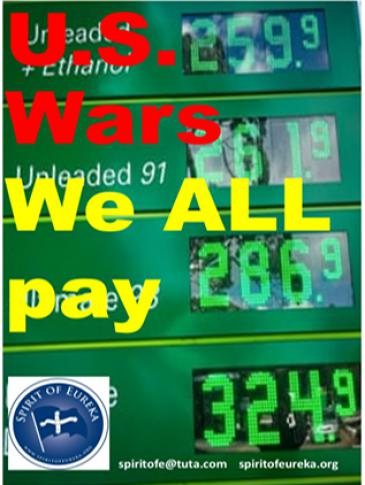
(Image courtesy Spirit of Eureka)
The US war with Iran has carried all the hallmarks of a military debacle: Iran's prolonged use of asymmetrical warfare techniques following US attacks in February appear to be successful. Vital energy supplies have been totally disrupted, with scarcity causing escalating prices for consumers who have been left to foot the bill for a Trump-led Cold War adventure in the Middle East. The US costs of the war are proving an acute embarrassment, with forthcoming mid-term elections next month expected problematic for the Trump administration. The whole military debacle would appear the outcome of a serious failure by the US intelligence services to accurately assess Iranian defence and security provision; the US, furthermore, appears to have no exit strategy from the theatre of their own operations.
The US has amassed a huge military presence in the Middle East, although it has not managed to control supply-lines for vital energy resources restricted by Iran. A third US aircraft carrier strike group and an additional 10,000 troops have still not altered the balance of forces in favour of Washington and the Pentagon. Nor is it likely to do so in the foreseeable future. Time is flowing against the US and its traditional hegemonic position.
While the US Navy has been responsible for escorting very large carriers of crude oil through the region, refining capacity for petrol and diesel has been restricted by Iran. (1) In fact, a recent report given to the London-based Energy Intelligence Forum noted that 'western stockpiles were now at the point of exhaustion'. (2) Tanks appear to be running very low. When the Group of Seven countries agreed last week to release a further hundred million barrels of crude oil together with fuel from emergency stock-piles, it might be among the last. (3)
Meanwhile, the global oil market has been thrown into highly volatile conditions: Brent, for example, peaked a three-year high at US$126 a barrel in April, following expectations of a ceasefire, it subsequently fell to US$70 a barrel in early July after the ceasefire was signed. (4) It has now risen again to over US$100 a barrel and continues to rise. The volatility has created havoc for planning in the construction and manufacturing industries and related logistics and transportation costs; the increasing scarcity of vital energy has caused large price increases for consumers.
Iranian reliance upon asymmetrical warfare techniques has included sporadic attacks upon vessels carrying oil, together with drone-based attacks on refineries in neighbouring countries. It has created havoc with supply-lines. Their attacks upon refineries in Saudi Arabia, Kuwait, the UAE, Iraq and elsewhere, have also had a psychological impact; most consumers now ask questions about longer-term US military planning and costs involved in prolonging the military fiasco. It might also include sensibilities: is it even winnable?
Iran was also successful at largely destroying the US main regional air-war command centre based in Qatar, which was given extremely limited media coverage and no official comment from the Pentagon. (5) In fact, elsewhere, in Saudi Arabia, a whole series of Houthi attacks have 'gone unacknowledged or been denied … Saudi officials put out new warnings to the public on Tuesday that filming and sharing images of drone and missile attacks, or interceptions, could bring legal charges'. (6) Silence, however, is not necessarily golden.
To date, the US has costed damage to their regional facilities by Iran to total about US$37.5 bn. (7) It continues to rise on the daily basis and is not included in overall costing.
The US are contending with a battlefield with poorly defined boundaries; a successful drone attack on the main Saudi Arabian East-West pipeline in early September, for example, was thought to have been activated and controlled from facilities based in Iraq. (8) Adversaries, for the Pentagon, are everywhere and nowhere; they spring up here, and there and disappear.
The recent revelations concerning USAF planes being based at the British Fairford air-base and their vulnerability to terrorist attacks following arrests of foreign nationals would tend to indicate Iran has vast networks of supporters in sensitive areas. (9) An official media release from London about Iran noted that 'without, so to speak, firing a single shot at RAF Fairford, has potentially reduced the ability of the US to strike Iran'. (10)
The opening of a second military front by the pro-Iranian Houthis on the coast of the Bab al-Mandeb Strait has also given rebels 'a vital choke-point in the global energy network'. (11)
In fact, a recent assessment of the US-Iran war has concluded that Iran's position has included concerns that 'its opportunity for asymmetrical warfare may be endless'. (12)
The US clearly has no military plan to deal with such scenarios; to date the war with Iran has already cost US$38 billion, with escalating costs of about US$2-3 for each month. (13) The Pentagon, furthermore, has recently requested a financial outlay of US$67 billion 'to continue operations … when many Americans are still trying to cope with escalating bills'. (14) Congress, furthermore, never even approved the war.
In conclusion, it would appear the US has experienced an intelligence failure to adequately assess the position of Iran and its allies. A recent wave of sackings and dismissals inside the Pentagon has tended to indicate the dysfunctional nature of its relationship with the Trump administration. One side does not appear to be co-operating with the other.
Resting upon well over a decade of operational attention placed upon assessments of 'emerging threats and more closely aligned with the CIA and elite military commando units', however, the Defence Intelligence Agency (DIA), nevertheless, has 1,600 'collectors' strategically placed in various US facilities. (15) Questions, therefore, arise: the outcome?
1. Diesel still stuck in Hormuz impasse, Australian, 7 October 2026.
2. Oil supply rebounds but prices stay pumped up, Australian, 8 October 2026.
3. Diesel still stuck, Australian, op.cit., 7 October 2026.
4. Oil supply rebounds, Australian, op.cit., 8 October 2026.
5. Drone pilot exposes base Achilles' heel, Australian, 9 October 2026.
6. Houthi attacks hit Saudi airports, Australian, 8 October 2026; and, Houthis' deadly hits on Saudi airports, Australian, 9 October 2026.
7. Why Iran and the Houthis don't need to defeat the US, Australian, 23 September 2026.
8. Houthis a force to be reckoned with after capture of crucial oil corridor, Australian, 16 September 2026.
9. US bomber exit from UK delivers win to Iran, Australian, 7 October 2026.
10. Ibid.
11. Houthi attacks hit Saudi airports, Australian, 8 October 2026.
12. Oil supply rebounds, Australian, op.cit., 8 October 2026.
13. Pentagon has burnt through $38 bn., Australian, 17 September 2026.
14. Hegseth asks for $67 bn for Iran War, Finance Buzz, 29 September 2026.
15. Pentagon plays the spy game, The Guardian Weekly (U.K.), 7 December 2012.
Print Version - new window Email article
-----
Go back
Independence from Imperialism
People's Rights & Liberties
Community and Environment
Marxism Today
International
Articles
| The US war with Iran – Trump’s military debacle |
| Palestine, Fascism and the Bankruptcy of Parliamentary Socialism |
| Revisionists say China cannot be imperialist |
| Press Statement by Nepal Communist Party (Mashal) |
| Party’s discussion paper published |
| 2026 Pacific Islands Forum: safe, not sorry? |
| “Imperialism wounds so many people. We can’t look away.” |
| Condemn the US placement of weapons in Outer Space |
| Pax Silica, the Philippines and US war preparations against China |
| New Zealand is being drawn into US plans to achieve military supremacy in space. |
| US-ROK Freedom Shield and other tensions |
| The forked tongue of US policy on the Asia Pacific |
| The Trump Administration and the scramble for the Pacific sea-bed |
| US developing kinetic and non-kinetic weapons for space war |
| The U.S. government, the Pentagon and big tech: key components of U.S. imperialism. Part 1 |
| Zionist war machine never so isolated |
| New booklet on China’s Imperialist Expansion |
| Country Report of the Socialist Party of Bangladesh to the ICOR Asia Conference, Kathmandu, Nepal 04.07.2026 |
| Asian Continental Report for ICOR Asian Conference |
| ICOR Asian Continental Conference - Report from Australia |
-----