
The significance of Diego Garcia for the US
Written by: (Contributed) on 8 March 2026
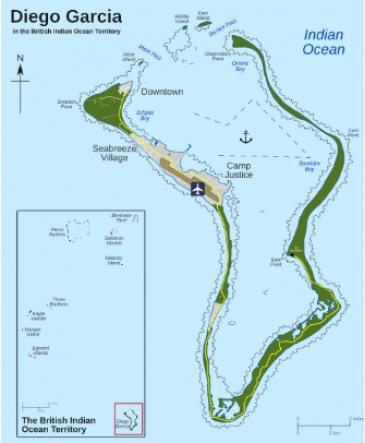
(Source: https://commons.wikimedia.org/)
As the Starmer government in the UK continues to dither about honouring a high-level diplomatic agreement with Mauritius concerning the sovereignty of Diego Garcia, the status of the joint US-UK base that exists there has been shown to have caused some difficulties in US-UK relations.
The UK government initially refused Trump’s request to use its military bases in support of the war with Iran. But on 1 March, Prime Minister Sir Keir Starmer announced he would, after all, permit the use of the UK’s overseas base on Diego Garcia. This is to be limited to ‘defensive’ action against missiles and drones based in Iran. This limited concession was reportedly negotiated with Washington, in accordance with London’s view on the legal issues involved.
Starmer’s vacillations led Trump to sledge him as “not a Winston Churchill”.
Concerns about Diego Garcia are regarded as sensitive.
The main reason of concern remains the changing nature of UK relations with the US and the failure of the Trump administration to access reliable intelligence assessments about China's diplomacy in the wider Indo-Pacific and Africa, and then act accordingly
In 2022, the British government began negotiations with their counterparts in Mauritius about the sovereignty of Diego Garcia, following a legal ruling by the International Court of Justice three years earlier that the UK should relinquish one of their last remaining colonial acquisitions. It was eventually resolved that Britain would transfer sovereignty of the tiny land-mass strategically placed in the centre of the vast Indian Ocean and also pay Mauritius $190 million a year for long-term rental. The finance was accompanied with strings to safeguard US and British interests.
It was acknowledged in official communiques that the reasoning behind the decision taken by Whitehall was that the proposal would guarantee western control of Diego Garcia, for example, against a backdrop of increasing competition from China.
In a manner similar to other geo-strategic outposts, Mauritius is regarded as a 'swing state' in competition between the US-led foreign policy and China. (1)
The arrangement between Britain and Mauritius did not include an established timeframe, although was generally acknowledged to be important after the official diplomatic signing last year. Since that time, however, the matter has continually been pushed down foreign policy agendas by the Starmer government in Westminster. The British are well-known for such delaying tactics although Starmer has already been openly criticised by members of his own Labour Party as not even possessing the suitable qualities of an M.P., let alone Prime Minister; he is a puppet. He remains, for example, part of an elite patronage system based on Leeds University and considered by those controlling class and state power to be a safe player for defending traditional British interests. Social change and traditional Labour politics is not an agenda item for the Starmer government despite it possessing a huge parliamentary majority. Social democracy has taken on a different meaning with Starmer.
The Starmer government remains, nevertheless, quite content to merely manage vast bureaucracies converging upon Whitehall, staffed by grey-flannelled faceless wonders serving patronage systems, designed to block any social change. The politics department at Leeds University produced vast numbers of such people. They look after each other well.
Recent dithering by the Starmer government over decisions about Diego Garcia remain, therefore, just one point of consideration. There are numerous other examples.
Behind the scenes, Diego Garcia has a chequered history; its strategic significance for US defence and security provision has been a central factor of consideration since the 1970s.
While falling into the hands of British colonial control in centuries past, Diego Garcia was forcibly cleared of its population during the 1960s and early 1970s and subsequently leased to the US for basing a highly sensitive intelligence facility, as part of a global network.
The intelligence facilities became fully operational in March 1973, linked into a global network and arc which included counterparts based at Silvermine in Apartheid South Africa, Abu Masa in Iran, Kagnew in Ethiopia, Subic Bay in the Philippines and Pine Gap in central Australia. (2) The diplomatic alliance between Australia and the US is primarily focussed upon the long-term and continued viability of Pine Gap.
Silvermine, moreover, was also the strategic link into a wider intelligence-gathering facilities, including NATO and the Southern Ocean Defence Plan, guaranteeing the Pentagon with defence and security provision spanning the South Atlantic and Indian Oceans. (3) The stated range of the Silvermine facilities reached Argentina to Bangladesh, northern Africa to Antarctica. (4)
Mauritius was also an important player in the intelligence network, being the main conduit through which telecommunications were channelled directly from Diego Garcia to Whitehall. (5) Similar to provisions for the Pentagon used facilities based in Puerto Rica. (6)
Since 1973, the US intelligence facilities based on Diego Garcia have been subject to continual upgrading. They now have the status of a military hub for operations, with a similar counterpart based in Guam in the Pacific, swinging on an arc from Pine Gap. (7) They, furthermore, use facilities based at Darwin Harbour as a support centre for regional and other deployments. (8)
What, however, has shaken US foreign policy considerations is the rapid rise of China as a serious competitor to traditional US-led hegemonic positions. In fact, a US congressional committee found the US were no longer the dominant power in the Pacific, nearly a decade ago; it has far-reaching implications for the use of Guam as a military hub for operations. (9) Pentagon intelligence assessments have, therefore, shifted toward the continued viability of Diego Garcia as the military hub for operations in the Indian Ocean. The outcome was the proposed agreement between the UK and Mauritius.
Coinciding with the findings of the US congressional committee, a military intelligence research finding drew attention to China's increasing role in the Indo-Pacific and Africa. (10) It was recommended that the US, therefore, should expand and upgrade their three-tier Island Chain Theory operational in the Asia-Pacific, to a fourth and fifth chains proposed for the Indian Ocean; the facilities based on Diego Garcia were central to the proposal. (11)
And there lies the main reason for the continual dithering on the part of the Starmer government and the position of the Trump administration, which have changed their position toward the proposed agreement with Mauritius on several occasions. (12) A day after the US State Department recently agreed to accept the Mauritius agreement with Britain, for example, a personal intervention by Trump halted US support. (13)
While the continually changing US position toward the Mauritius agreement is, in part, due to the mindset and cognitive disposition of Trump, it also reveals a general failure by the US to accurately assess the nature of China's diplomacy in the Indo-Pacific and Africa, and then create a general agreement inside the corridors of power; Washington and the Pentagon, however, appear increasingly dysfunctional. The problem starts at the top and flows in a downward direction toward lesser minions.
Elsewhere, in the Middle East, former associates and analysts employed by the Trump administration have spoken openly about how 'the president fundamentally fails to grasp' analytical and intelligence assessments. (14) There is little reflective insight in his decision-making; his closest associates, who he presumably calls upon for advice, include family real estate financiers, a dried-out alcoholic and a former heroin addict with a fourteen-year history. They are not insightful, educated people, but remain part of a coterie of intrigue.
To date, the Starmer government have stated they will not go ahead with the Mauritius agreement without US support. It has provided a convenient cover played out by dithering and a continued sycophantic prime minister in Westminster. The puppet is squirming.
Meanwhile, the clock remains slowly ticking away with an acknowledgement that, 'Diego Garcia … allows the US to project power across a vast part of the region and is seen as increasingly strategic at a time when a more assertive China is rivalling US influence in the Indo-Pacific, including a close relationship with Mauritius'. (15) No ambiguity.
The implications for the US failing to act accordingly are potentially far-reaching.
A former advisor to the Starmer government has already been quoted, for example, stating, 'it was pressure from the Biden administration that helped push the UK to strike the deal … giving sovereignty to Mauritius would help US and British interests by preventing the island from allying long-term with China'. (16) Political expedience was the order of the day.
The Trump administration, however, appear to see the world rather differently. That is, if they see it at all. They appear oblivious. The government of Mauritius together with a number of influential international bodies, nevertheless, have already stated that honouring the agreement 'is the only way to ensure the long-term security of the base'. (17)
1. Chagos deal halt to pacify Trump, Australian, 27 February 2026.
2. Essential instruments of US strategy, two new gendarmes: Iran and South Africa, Le Monde Diplomatique, December 1976.
3. Maritime Operational and Communications Headquarters, The Star (South Africa), 10 March 1973; and, Silvermine Communications Centre, Signals Units of the South African Corps of Signals and related services, Walter Volker, (Pretoria, 2010), page 609; and, Not in Europe Alone, John Biggs-Davison, M.P., Brassey's Annual: Defence and the Armed Forces, 1972, pp. 78-89, which states: “Australia is one of three A's of the southern ocean defence system … the other two being South Africa and Argentina” (page 87).
4. Star, ibid.
5. Security in the mountain, The Star (South Africa), 17 March 1973.
6. Ibid.
7. See: US intensifies military presence in Indo-Pacific, The Global Times (Beijing), 24 July 2018.
8. Ibid.
9. Study: US no longer dominant power in the Pacific, Paul D. Shinkman, Information Clearing House, 22 August 2019.
10. See: China's reach has grown, Asia Maritime Transparency Initiative, 22 October 2018.
11. Ibid.
12. Chagos deal, Australian, op.cit., 27 February 2026.
13. Ibid.
14. Iran 'ready to spill American blood – even at huge cost', Australian, 27 February 2026.
15. Chagos deal, Australian, op.cit., 27 February 2026.
16. Ibid.
17. Ibid.
Print Version - new window Email article
-----
Go back
Independence from Imperialism
People's Rights & Liberties
Community and Environment
Marxism Today
International
Articles
| Condemn the US placement of weapons in Outer Space |
| Pax Silica, the Philippines and US war preparations against China |
| New Zealand is being drawn into US plans to achieve military supremacy in space. |
| US-ROK Freedom Shield and other tensions |
| The forked tongue of US policy on the Asia Pacific |
| The Trump Administration and the scramble for the Pacific sea-bed |
| US developing kinetic and non-kinetic weapons for space war |
| The U.S. government, the Pentagon and big tech: key components of U.S. imperialism. Part 1 |
| Zionist war machine never so isolated |
| New booklet on China’s Imperialist Expansion |
| Country Report of the Socialist Party of Bangladesh to the ICOR Asia Conference, Kathmandu, Nepal 04.07.2026 |
| Asian Continental Report for ICOR Asian Conference |
| ICOR Asian Continental Conference - Report from Australia |
| “We must ensure the next war is won, not lost, in space” says retired US Air Force general |
| Report from Sri Lanka |
| 'Dispersed operations': Pentagon upgrades the Indo-Pacific Strategy |
| ICOR declaration: Forward with the popular uprising in Bolivia, an end to oppression! |
| Contradictions and conflicts in the race for Space |
| Can the US withstand the BRICS challenge? |
| Fight the Militarisation of Space |
-----